How 24/7 Contrast Supervision Increases Imaging Center Revenue in 2026
This article explores how 24/7 contrast supervision helps imaging centers increase revenue, prevent cancellations, and meet evolving CMS and ACR expectations for contrast administration in 2026. It also answers common questions patients and administrators ask when evaluating virtual contrast supervision models.

Tether Supervision
Imaging Center Operations

Imaging centers are operating in a very different healthcare economy than they were five years ago. When every delayed CT or MRI exam affects revenue, staffing, and patient satisfaction, centers are searching for reliable ways to keep schedules running and reduce financial leakage. One of the fastest growing areas of operational improvement is contrast supervision. Many leaders still view contrast coverage as a compliance requirement. In reality, the way you supervise contrast exams directly shapes your monthly revenue, your patient throughput, and your ability to compete with nearby facilities.
Why does contrast supervision matter so much for revenue?
Contrast supervision refers to the real-time availability of a supervising physician during a contrast-enhanced CT or MRI exam. It ensures rapid assessment of symptoms, immediate guidance if a reaction occurs, and compliance with supervision rules that apply to outpatient imaging. When supervision is not available, exams often need to be delayed or canceled. Each cancellation represents a direct revenue loss. It also disrupts the schedule, frustrates referring clinicians, and increases the odds that the patient goes elsewhere next time.
In high-volume centers, even a few missed contrast exams per week can accumulate into thousands of dollars in unrecoverable revenue every month. In markets with strong competition, inconsistent contrast supervision creates bottlenecks that competitors take advantage of.
What revenue gains come from consistent 24/7 supervision coverage?
Many imaging center leaders underestimate the financial benefit of uninterrupted contrast coverage. When you ensure supervision is available at all operating hours, more of your scheduled CT and MRI patients can be scanned on the same day. You reduce the number of patients who are sent home because a supervising physician is unavailable. You also eliminate the need to stack contrast exams into the middle of the day because of staffing limitations.
The result is a smoother schedule, higher exam throughput, and more predictable revenue. In addition, centers often capture new appointment volume because patients appreciate facilities that accommodate early mornings, evenings, or weekends.
What strategies help imaging centers maximize revenue with 24/7 supervision?
Extend operating hours
Extended hours allow you to serve patients who cannot come during the traditional workday. Early morning and late evening availability are some of the highest converting appointment types. If your center has the staff and equipment, these hours generate incremental revenue without adding capital costs.
Offer flexible 24/7 supervision
Flexible coverage is one of the strongest differentiators for imaging centers. When supervision is always available, scheduling becomes much simpler. Technologists no longer delay contrast cases or batch them. Patients who require contrast can be scanned whenever they arrive. This prevents revenue loss from same-day cancellations and positions your center as more reliable than competitors.
Build a marketing message around availability
Patients, referring providers, and hospital partners want to know that their cases will be handled safely and on time. Promote your extended hours and 24/7 supervision on your website, Google Business Profile, paid search ads, and social channels. Many centers also create simple landing pages that highlight their availability for contrast CT and MRI, which helps with local SEO.
Expand your service mix with reliable coverage
Once staffing bottlenecks are removed, centers often add new types of exams and niche services that previously felt too difficult to support. These may include angiography studies, pediatric slots, and exams that require additional observation. Reliable contrast coverage broadens what your center can safely offer, which increases referral volume and case complexity.
Is 24/7 contrast supervision worth it for small or rural imaging centers?
Yes. Small centers feel the financial impact of canceled contrast exams even more acutely. When a single cancellation can represent several hundred dollars in lost revenue, and when rescheduling creates additional administrative burden, consistent supervision provides stability. Many rural centers also use virtual contrast supervision to avoid overstaffing or relying on on-call radiologists who may not always be available.
What problems does 24/7 contrast supervision solve that administrators often overlook?
Many directors discover secondary benefits they did not anticipate. These include improved technologist satisfaction because staff no longer scramble to find a supervising physician, fewer patient complaints about long wait times, and stronger relationships with referring clinicians who want predictable turnaround times. Centers also reduce regulatory risk by ensuring they meet CMS and ACR supervision rules for contrast administration every day of the year.
Final takeaways for imaging centers planning growth in 2026
Twenty-four hour contrast supervision is not only a patient safety requirement. It is a revenue strategy. It prevents same-day cancellations, supports extended operating hours, boosts referral volume, and stabilizes schedules. Centers that adopt consistent coverage position themselves for growth in an increasingly competitive imaging market.
To learn more about optimizing revenue, explore the hidden operational and compliance costs that arise when imaging centers attempt to bypass direct supervision requirements for contrast-enhanced diagnostic radiology.

Read more from Tether Supervision

Why is Epinephrine Crucial for Outpatient Imaging Centers?
For outpatient imaging centers, ensuring patient safety during contrast-enhanced procedures is paramount. Given the potential for severe allergic reactions to iodinated contrast media, every facility must be equipped with epinephrine to manage anaphylaxis effectively. Epinephrine is the first-line treatment for anaphylaxis. No other medication stops the life-threatening effects of anaphylaxis.
Allergic contrast reactions are rare (0.2–0.6% of all injections) and can range from mild rashes to life-threatening anaphylaxis.1,2 Although the vast majority of these are self-limited, delayed epinephrine administration can be fatal in cases of severe reactions.
Epinephrine typically takes effect within three to five minutes, with intramuscular injection into the anterolateral thigh being the preferred route.3 In outpatient settings, epinephrine auto-injectors offer a practical advantage, allowing for faster administration and reducing the risk of dosing errors.4 When used at recommended doses, epinephrine is highly safe, with common side effects including agitation, anxiety, tremors, or headache. There are no absolute contraindications for its use in anaphylaxis. Because the progression of an allergic reaction is unpredictable, early administration should be strongly considered, even for mild symptoms or single-system involvement.4
Intramuscular Epinephrine: The Foundation of a Smart Contrast Reaction Protocol
Intramuscular (IM) administration of epinephrine for anaphylaxis is the preferred route due to its proven safety profile and ease of use, as endorsed by multiple international guidelines.4–7 IM injection is widely recognized as a safe and effective method in both clinical and non-clinical settings—even school teachers have been successfully trained to administer it.8,9 While the American College of Radiology’s Manual on Contrast Media now requires only IM epinephrine as part of its minimum equipment standards.10
Why Protocolization Matters
In high-stakes environments, from aviation to surgery, checklists and standardized protocols are essential in preventing errors and improving outcomes. The same applies to contrast reaction management—having a clear, step-by-step process eliminates guesswork and reduces the risk of critical mistakes.
Without standardized protocols and education, providers can struggle with epinephrine administration. Studies have shown that in the absence of structured guidelines, errors occur such as
Administering IV epinephrine instead of IM.
Failing to administer epinephrine at all.11,12
These mistakes delay life-saving treatment and increase risks for patients. However, a simple, well-designed protocol—complete with checklists and auto-injectors—ensures that every provider can act confidently and correctly in an emergency.
Benefits of Auto-Injectors
Compared to manual epinephrine administration, auto-injectors offer several advantages:
1. Faster Administration
A study comparing manual injection vs. auto-injector in a simulated contrast reaction found that auto-injectors cut administration time by more than half (38.7 vs. 108.8 seconds)13
In an emergency, every second counts—delays in administration increase the risk of fatality.
2. Reduced Risk of Dosing Errors
Epinephrine auto-injectors come preloaded with a fixed dose, eliminating the risk of drawing up the wrong amount.
Manual injections require calculating and measuring doses, leaving room for human error—especially under stress.
3. Easier for Non-Physician Staff to Use
Auto-injectors require fewer steps and provide step-by-step instructions during use.
This makes it easier for nurses, technologists, or administrative staff to administer the injection correctly.
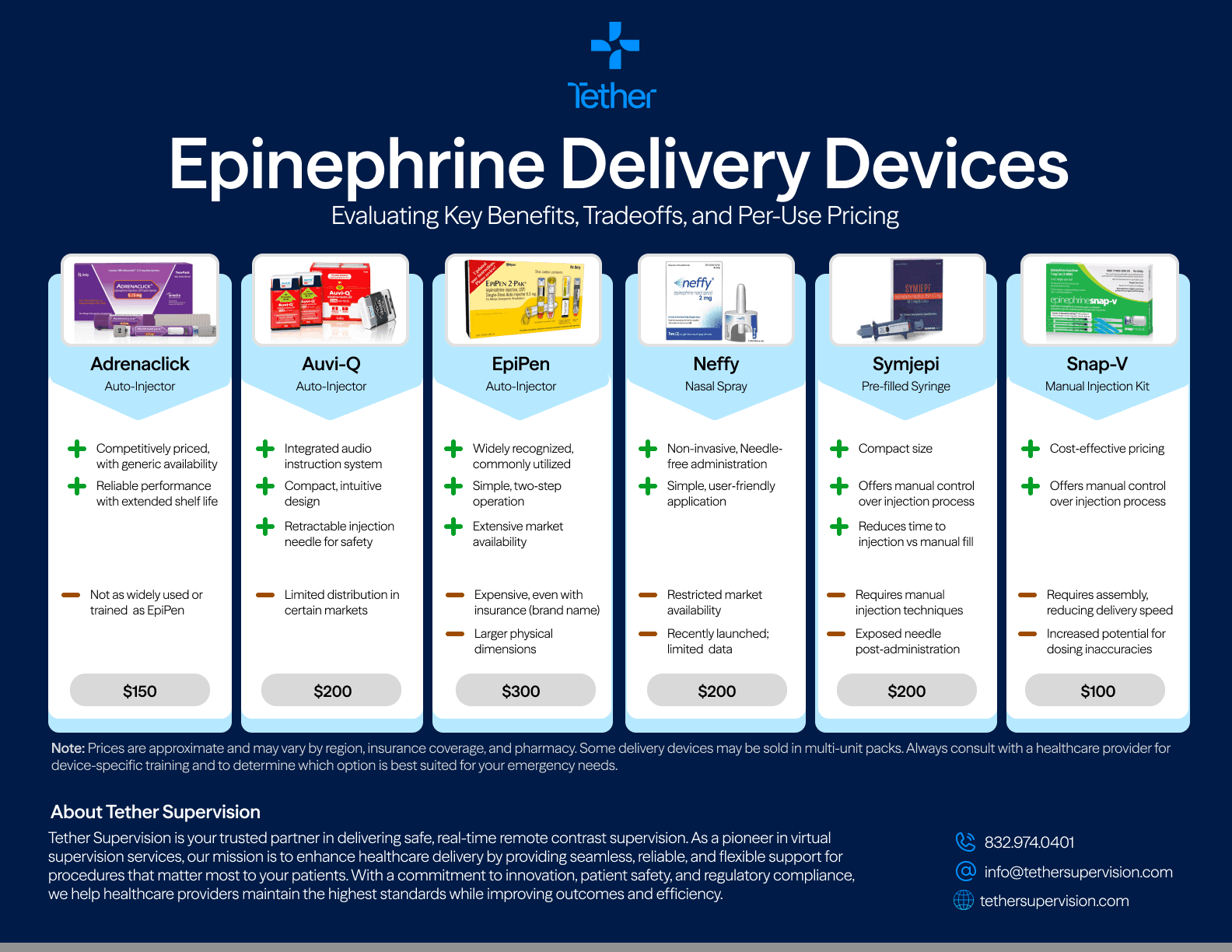
Outpatient imaging centers should be aware of various epinephrine delivery options in case of contrast-related anaphylaxis. The EpiPen is the most widely recognized auto-injector, while Auvi-Q offers voice-guided instructions and a retractable needle for added safety. Adrenaclick provides a lower-cost alternative but requires slightly different administration steps, and Neffy, a new needle-free nasal spray, may be preferred by patients with needle aversion. Symjepi and Epinephrine Snap Kit require manual injection and are generally lower-cost but demand more training and confidence in administration.
Final Recommendation
For most outpatient imaging centers performing contrast studies, epinephrine auto-injectors are the safest, most effective option with a proven track record. Given the potential for anaphylaxis, quick, error-free administration is essential.
At our organization, we prefer to work with centers that stock auto-injectors to ensure:
Faster administration.
Fewer medical errors.
Increased staff confidence.
Better patient outcomes.
Make the right choice for your imaging center.
References:
1. Wang CL, Cohan RH, Ellis JH, Caoili EM, Wang G, Francis IR. Frequency, Outcome, and Appropriateness of Treatment of Nonionic Iodinated Contrast Media Reactions. Am J Roentgenol. 2008;191(2):409-415. doi:10.2214/AJR.07.3421
2. Cochran ST, Bomyea K, Sayre JW. Trends in Adverse Events After IV Administration of Contrast Media. Am J Roentgenol. 2001;176(6):1385-1388. doi:10.2214/ajr.176.6.1761385
3. Muraro A, Roberts G, Worm M, et al. Anaphylaxis: guidelines from the European Academy of Allergy and Clinical Immunology. Allergy. 2014;69(8):1026-1045. doi:10.1111/all.12437
4. Simons FER, Ebisawa M, Sanchez-Borges M, et al. 2015 update of the evidence base: World Allergy Organization anaphylaxis guidelines. World Allergy Organ J. 2015;8:32. doi:10.1186/s40413-015-0080-1
5. Cardona V, Ansotegui IJ, Ebisawa M, et al. World Allergy Organization Anaphylaxis Guidance 2020. World Allergy Organ J. 2020;13(10):100472. doi:10.1016/j.waojou.2020.100472
6. Pflipsen MC, Vega Colon KM. Anaphylaxis: Recognition and Management. Am Fam Physician. 2020;102(6):355-362.
7. Lieberman P, Nicklas RA, Randolph C, et al. Anaphylaxis—a practice parameter update 2015. Ann Allergy Asthma Immunol. 2015;115(5):341-384. doi:10.1016/j.anai.2015.07.019
8. Donovan P, O’Connor P. The confidence and competence of primary school staff to administer an adrenaline auto-injector. Eur J Pediatr. Published online 2024:1-6.
9. Lejtman P, Hetroit-Vasseur E, Morello R, Vial S, Brouard J. Evaluation of a video training program’s impact on primary teachers’ knowledge of allergies and skills in using an adrenaline autoinjector during the 2021–2022 school year. Arch Pédiatrie. 2024;31(5):299-305. doi:10.1016/j.arcped.2024.03.003
10. ACR Manual on Contrast Media. Published online 2024. https://www.acr.org/-/media/ACR/Files/Clinical-Resources/Contrast_Media.pdf
11. Lightfoot CB, Abraham RJ, Mammen T, Abdolell M, Kapur S, Abraham RJ. Survey of Radiologists’ Knowledge Regarding the Management of Severe Contrast Material–induced Allergic Reactions. Radiology. 2009;251(3):691-696. doi:10.1148/radiol.2513081651
12. Nandwana SB, Walls DG, Torres WE. Radiology Department Preparedness for the Management of Severe Acute Iodinated Contrast Reactions: Do We Need to Change Our Approach? Am J Roentgenol. 2015;205(1):90-94. doi:10.2214/AJR.14.13884
13. Asch D, Pfeifer KE, Arango J, et al. JOURNAL CLUB: Benefit of Epinephrine Autoinjector for Treatment of Contrast Reactions: Comparison of Errors, Administration Times, and Provider Preferences. Am J Roentgenol. 2017;209(2):W363-W369. doi:10.2214/AJR.16.17111