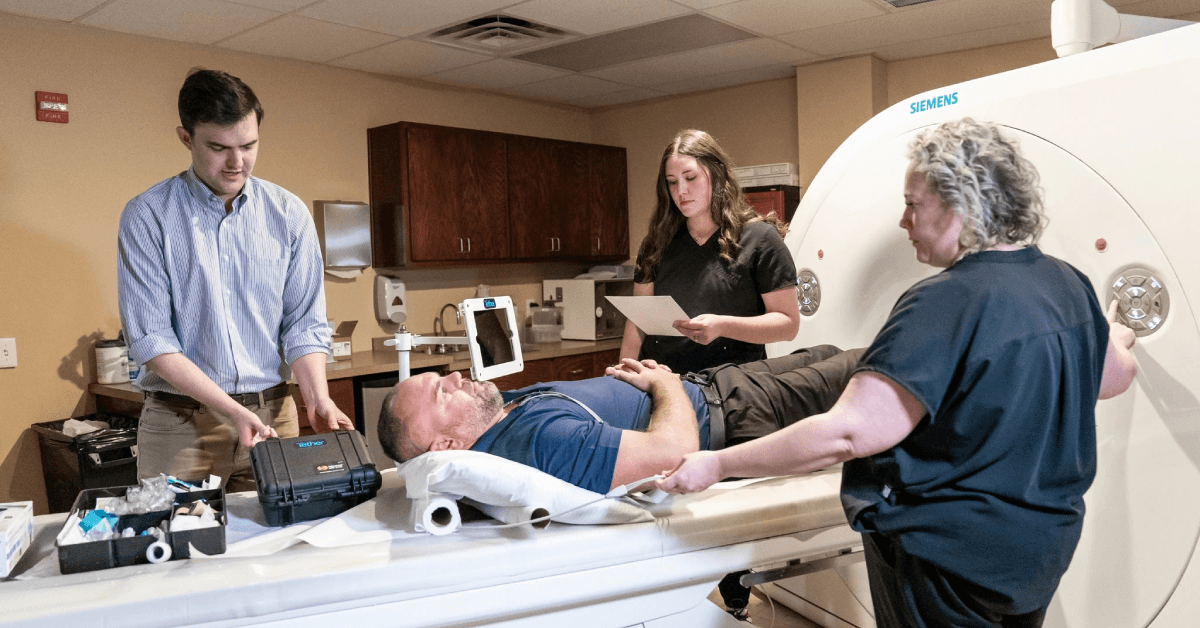
The First Published High-Acuity Contrast Reaction Managed Through Virtual Contrast Supervision

A Radiology Case Reports case report documents the first high-acuity iodinated contrast reaction managed through a telemedicine-enabled supervision model using Tether Supervision.

Tether Supervision

Virtual Contrast Supervision

A newly published case report in Radiology Case Reports marks an important milestone for virtual contrast supervision. The article, “Telemedicine-guided management of iodinated contrast media-associated anaphylaxis: A case report,” documents the first high-acuity contrast reaction managed through a telemedicine-enabled supervision model. The platform used in the case was Tether Supervision.

The case is important not only because of what happened clinically, but because it shows what a rigorous virtual supervision model looks like in practice.

A severe reaction develops within minutes

A 63-year-old woman undergoing an outpatient CT pelvis with iodinated contrast developed pruritus and diffuse urticaria approximately two minutes after injection. Her condition deteriorated rapidly. She became pale and confused, with a blood pressure of 70/47 mmHg, oxygen saturation in the 70%–80% range, labored respirations, and signs concerning for upper-airway involvement. The clinical picture met accepted criteria for anaphylaxis.

The technologist stopped the scan, initiated the site’s emergency response protocol, and activated Tether Supervision’s emergency alert.

Physician engagement in approximately 20 seconds

A critical feature of the workflow was that the supervising physician was already connected to the imaging center through a persistent real-time audiovisual supervision session. When the technologist activated Tether’s emergency alert, the system immediately directed the physician’s attention to the correct site. Live video communication was established in approximately 20 seconds.

That distinction matters. In a high-acuity emergency, the workflow should not begin with trying to find a physician. The physician should already be available, and the system should be designed to immediately localize their attention to the patient who needs help.

Real-time management of anaphylaxis

Under remote physician guidance, the on-site team administered intramuscular epinephrine, initiated high-flow oxygen, and performed airway-positioning maneuvers. EMS was activated. When hypotension and respiratory compromise persisted, the physician directed a second dose of intramuscular epinephrine. A nasopharyngeal airway was placed, and oxygenation and blood pressure subsequently improved.

The supervising physician remained connected through EMS arrival and participated in the handoff. The patient was transported to the emergency department, where progressive laryngeal edema required intubation for airway protection. She was extubated the following day and discharged home two days later.

Virtual supervision is not just a video connection

One of the most important lessons from the case is that effective virtual contrast supervision depends on far more than teleconferencing technology. Before the event, the responding technologist had completed physician-led contrast-reaction management training provided by Tether Supervision and the imaging center. That training addressed reaction recognition, emergency escalation, and physician-directed interventions during acute events.

The article also emphasizes the importance of standardized epinephrine protocols, airway equipment, IV fluid capability, reliable audiovisual connectivity, and simulation-based training. That is exactly how Tether approaches virtual supervision: as a clinical operating system, not simply a remote physician on a screen.

Why academic rigor matters

Virtual contrast supervision is still an evolving model. As adoption expands, the industry will need more than claims, anecdotes, and internally produced content. It will need evidence.

That means documented clinical outcomes, transparent workflows, physician-led training, thoughtful protocol design, and peer-reviewed publication. This case report is a meaningful step in that direction. It was published in a medical journal and authored by physicians affiliated with McGovern Medical School, Stanford University, and the Uniformed Services University of the Health Sciences.

For Tether, that level of scrutiny is not incidental to the model. It is part of the model. Clinical services should be held to clinical standards.

Rare events require exceptional preparedness

Severe reactions to iodinated contrast media are uncommon. The paper notes that the American College of Radiology estimates severe allergic-like reactions to modern iodinated contrast media at approximately 0.04%. But rarity can create its own challenge: imaging teams may go months or years without encountering a severe reaction. When one occurs, the response still has to be immediate, accurate, and coordinated.

The literature cited in the case report also highlights the difficulty of these events. Studies have documented frequent epinephrine administration errors during simulated severe contrast reactions, including errors involving dose, route, concentration, and equipment. That is why preparedness cannot begin when the emergency happens. It must already exist in the training, workflows, equipment, technology, and people.

Building the standard for virtual contrast supervision

This case demonstrates what can happen when those pieces work together: a trained technologist recognizes a rapidly deteriorating patient, an already-connected physician is engaged within seconds, evidence-based treatment begins, EMS is activated, and care remains coordinated through handoff. That is the standard Tether is working to build across every imaging center we support.

As virtual supervision becomes a larger part of outpatient imaging, we believe the companies providing it should be judged not simply by whether they can provide coverage, but by the quality of their clinical systems, their training, their preparedness, and the evidence supporting their approach.

We are proud to see Tether’s model documented in the medical literature. More importantly, we are proud of the technologists and physicians who demonstrated what that model looks like when the stakes are highest.

Take the uncertainty out of contrast supervision.

We’ll support your team every step of the way, from onboarding and training to live supervision and ongoing quality improvement.

Take the uncertainty out of contrast supervision.

We’ll support your team every step of the way, from onboarding and training to live supervision and ongoing quality improvement.

Read more from Tether Supervision

Tether is the leading platform for virtual contrast supervision, built for speed, safety, and seamless imaging operations.

Expert perspectives on safe, efficient contrast workflows and clinical readiness.

Tether is the leading platform for virtual contrast supervision, built for speed, safety, and seamless imaging operations.

Radiology technologist operating CT imaging consoles alongside a Tether Supervision virtual contrast supervision unit, providing real-time radiologist oversight for safe, compliant contrast administration in outpatient imaging centers.

American Society of Radiologic Technologists and Tether Supervision Partner to Develop Contrast Reaction Management Series for Radiologic Technologists
ALBUQUERQUE, N.M., and HOUSTON, Texas — [Month Day, 2026] — The American Society of Radiologic Technologists and Tether Supervision announced a strategic partnership to develop the Advanced Contrast Management Series, a comprehensive continuing education program designed to equip medical imaging and radiation therapy professionals with the skills to recognize, assess and respond to contrast-related adverse events with greater speed, consistency and clinical confidence. 

Within the collaboration, Tether Supervision will co-develop course content grounded in real-world outpatient imaging workflows, while ASRT will host the course in the ASRT Store

The program is designed to move beyond theoretical instruction and emphasize applied clinical readiness. Core modules will focus on structured contrast reaction classification and severity assessment, rapid patient evaluation, airway-breathing-circulation stabilization, focused clinical examination and closed-loop emergency communication. The series also addresses medication and equipment preparedness, along with standardized treatment pathways for high-acuity events, including anaphylaxis, bronchospasm, pulmonary edema, laryngeal edema, urticaria and extravasation. 

Training is delivered through practical, scenario-based clinical application, reinforcing rapid recognition, clear prioritization and decisive intervention under pressure, reflecting the realities of outpatient imaging settings where immediate response is critical.

“Medical imaging and radiation therapy professionals are on the front line of patient care during contrast-enhanced imaging, and when adverse reactions occur, preparation is critical,” said ASRT CEO Melissa B. Pergola, Ed.D., R.T.(R)(M), FASRT, CAE. “This collaboration reflects ASRT’s commitment to education that is practical, clinically relevant and focused on improving patient outcomes. By partnering with Tether Supervision, we will provide a program that translates high-acuity scenarios into clear, actionable training.”

“Effective contrast reaction management requires more than theory – it requires a repeatable operational framework for assessment, communication and intervention,” said Cory Wynn, chief executive officer of Tether Supervision. “Partnering with American Society of Radiologic Technologists allows us to combine field-tested supervision experience with a trusted educational platform, helping imaging teams build consistent readiness across every site and every shift.”

The CE series will draw on Tether Supervision’s established contrast reaction training framework and clinical leadership, including contributions from Sam Beger, M.D., M.P.H., board-certified emergency medicine physician with fellowship training in space medicine. His instruction emphasizes structured emergency response, rapid clinical assessment and consistent escalation protocols in high-risk scenarios.

The partnership aligns ASRT’s mission to advance and elevate the medical imaging and radiation therapy profession and enhance quality, safe patient care with Tether Supervision’s focus on expanding access to expert radiology supervision through standardized workflows, clinical rigor and modern technology.

Additional details regarding course availability, enrollment and launch timing will be announced in the coming months.

About ASRT
Founded in 1920, the American Society of Radiologic Technologists is the world’s largest and oldest membership association for medical imaging and radiation therapy professionals. ASRT is dedicated to advancing the medical imaging and radiation therapy profession and enhancing patient care through education, advocacy and professional development.

About Tether Supervision
Tether Supervision is a physician-led platform providing virtual and on-site direct supervision for contrast-enhanced CT and MRI across the United States. The company delivers an integrated clinical and technology infrastructure combining real-time audio-video supervision, structured workflows and operational oversight. Its system enables continuous physician availability, standardized escalation and documented response tracking, helping imaging centers improve safety, maintain regulatory compliance and scale access to care without compromising clinical quality.

Media Contacts
American Society of Radiologic Technologists
PR@asrt.org

Tether Supervision Media Relations
Press@tethersupervision.com

Radiology technologist operating CT imaging consoles alongside a Tether Supervision virtual contrast supervision unit, providing real-time radiologist oversight for safe, compliant contrast administration in outpatient imaging centers.

Retaining Human Touch in a High-Tech Specialty
Over the course of my career in radiology, I have watched this field evolve in extraordinary ways. I have lived through the digitization of images, the expansion of access, and the steady improvement of technology that has made radiology faster, sharper and more connected. That progress is real, and it has done a tremendous amount for patient care. We should celebrate it and continue building upon it. 

But the longer I have worked in and around imaging, the more convinced I have become of something simple: no matter how advanced radiology becomes, we cannot forget the patient at the center of it all. Patients may appreciate technology, but what they remember most is whether someone helped them feel informed, cared for and less alone.

Most of us can think of a time when we were sick, worried, or waiting for an answer, and one physician encounter made the experience a little less frightening. I think often about a moment like that involving my friend Dr. Rob Liddell. He took the time to call my wife, Rachel, and explain what the report meant in layman’s terms. He did not just repeat the language on the page. He translated it. He answered the questions that matter most to patients: What does this mean? How worried should I be? What are the next steps? That call changed the entire experience. It brought clarity where there had been confusion and reassurance where there had been anxiety.

Today, patients often see their radiology reports quickly through online portals, sometimes before they have had a meaningful conversation with the physician who ordered the study.  Radiology reports are written to be precise, but for patients they can also feel long, technical and intimidating. Communication is not some side issue in radiology; RSNA has noted that this shift is creating a new need for clearer communication and more direct engagement from radiologists.1,2

I have spent much of my career on the business and operational side of imaging, and from that vantage point I can say just as clearly that the humanity we bring each day is not a soft “extra”. It is part of quality. It is part of trust. It is part of loyalty. Patients may not always be able to judge the technical details of the equipment or an interpretation, but they absolutely remember how an experience made them feel. One national analysis of patient reviews found that the words most associated with positive radiologist reviews were “caring,” “knowledgeable” and “professional,” while negative reviews most often used words like “rude,” “pain” and “unprofessional.”3

I have seen that reality play out in imaging centers throughout my career. The centers that stand out are rarely defined by technology alone. They are the ones where the front desk welcomes people warmly, where staff members explain what is about to happen, where a smile is genuine, and where a patient leaves feeling that the team noticed the person and not just the exam. Those details are not cosmetic – they shape the care experience and determine whether people trust you enough to return.

That is why I am especially proud of what we are building at Tether Supervision. Even in a virtual supervision model, we have made it a priority to preserve the patient-centered interactions, alongside our imaging center partners. Virtual supervision should never mean distant care. When a patient has a difficult experience or needs added reassurance, they are face-to-face with one of our physicians.  In addition, every patient that has an incident receives a callback from one of our physicians within 48 hours to follow-up on their discharge and care.  We have heard story after story from our patients who were deeply appreciative simply because someone reached out, explained what happened, answered questions, and made clear that we cared.

A specific example really resonates with me.  We had a patient who experienced an anaphylactic reaction and ended up in the ICU. Later, when she needed imaging again, she returned to the same imaging center for a non-contrast study. This does not happen by coincidence or accident. She came back because of trust. She remembered the follow-up. She remembered that someone checked on her. She remembered that the care did not stop the moment the immediate event was over.

Experiences like this are not anecdotal – research helps explain why they matter. Studies of post-discharge phone calls have found meaningful improvements in patient satisfaction and in patients’ likelihood to recommend a care setting. In one emergency medicine study, patients who reported receiving a follow-up call were far more likely to give the highest recommendation rating than those who did not. Another study found that follow-up calls created more opportunities to clarify instructions and improve the overall discharge experience.4,5

Patients are also telling us that they want both convenience and confidence. A recent study of diagnostic imaging preferences found that patients value lower costs and shorter waits, but they also care about specialty radiologist interpretation, primary care recommendation, online scheduling, and strong service ratings.6

That feels exactly right to me. Innovation matters. Convenience matters. Efficiency matters. But the future of radiology cannot be just about speed, scale and sophistication. It also must be about connections – call centers, front desks, technologists, nurses, and physicians. We should absolutely keep embracing new technology. We should keep improving systems, workflows, and access. But we cannot let efficiency crowd out empathy.

At the end of the day, patients are not living inside our workflows. They are the reason for our work and are living inside uncertainty, anxiety, and fear. A kind voice over the phone, a physician who takes time to explain the report, a thoughtful callback after a hard experience, a team member who greets someone with warmth instead of haste — those things still matter enormously. In some cases, they are the difference between a stressful encounter and one that leaves a patient feeling steady, informed, and cared for.

Radiology has accomplished amazing things technologically. The opportunity now is to ensure our humanity keeps pace with our technology - and never falls behind it.  This responsibility belongs to every radiologist, every imaging center, and every system shaping the patient experience.


About Michael Douglas

Michael Douglas is Chief Revenue Officer at Tether Supervision and a veteran healthcare executive with over 20 years of leadership in outpatient imaging. He has served as CEO of SMIL (Southwest Medical Imaging, Ltd.) and held senior roles at Alliance HealthCare Services and Center for Diagnostic Imaging, where he led large-scale imaging operations, physician partnerships, and multi-state growth initiatives.


Selected References

1. McKee J. Radiologist-Patient Communication Skills in the Digital Age. RSNA News. October 25, 2023.

2. Silverberg M. The Key to Success in Radiology? Build Your Communication Skills. RSNA News. May 24, 2021.

3. Ginocchio LA, Duszak R Jr, Rosenkrantz AB. How Satisfied Are Patients With Their Radiologists? Assessment Using a National Patient Ratings Website. AJR Am J Roentgenol. 2017;208(5):W178-W183. doi:10.2214/AJR.16.17298.

4. Guss DA, Leland H, Castillo EM. The Impact of Post-Discharge Patient Call Back on Patient Satisfaction in Two Academic Emergency Departments. J Emerg Med. 2013;44(1):236-241. doi:10.1016/j.jemermed.2012.07.074.

5. Fagan SAK. Post-discharge Phone Calls in the Emergency Department: Do Follow-Up Calls Increase Patient Satisfaction and Reduce Post-Discharge Complications? Doctor of Nursing Practice Scholarly Projects. University of South Carolina. 2021.

6. van den Broek-Altenburg EM, Benson JS, Atherly AJ, DeStigter KK. Patient preferences for diagnostic imaging services: Decentralize or not? PLoS One. 2025;20(5):e0301404. doi:10.1371/journal.pone.0301404.

Radiology technologist operating CT imaging consoles alongside a Tether Supervision virtual contrast supervision unit, providing real-time radiologist oversight for safe, compliant contrast administration in outpatient imaging centers.

What the RadSite Panel Revealed About the Future of Virtual Supervision for IV Contrast in CT & MRI

I recently had the opportunity to join the RadSite panel discussion on March 11, 2026, focused on the impact of virtual supervision and remote scanning on administration of IV contrast in CT and MRI imaging.

It was a valuable conversation because it addressed a question more imaging leaders are now asking: Is virtual supervision simply an operational workaround, or is it actually a better model for patient safety, access, and consistency?

The panel, which included Eliot Siegel, MD (RadSite), myself (Sam Beger, MD, MPH) (Tether Supervision), Michael Coords, MD (RadNet), Laura Foster, MPH, JD (Former SVP Compliance, RadNet), and Dor Shoshan, MD (ContrastConnect), shared a clear consensus:

When virtual supervision is implemented correctly, it is not a downgrade from traditional on-site coverage. In many cases, it promotes a stronger, faster, and more standardized model for contrast supervision in outpatient imaging.

At Tether Supervision, this is exactly how we approach it.

The conversation has changed

For years, the imaging industry treated direct supervision as something tied almost entirely to physical presence. If a physician was somewhere on-site and could be located when needed, that was often viewed as sufficient.

However, that framework was shaped by older limitations. It came from a time before always-on, secure, two-way audiovisual communication. Before purpose-built workflows. Before modern escalation systems. Before many centers had practical ways to extend physician coverage across distributed outpatient sites without compromising responsiveness.

This is no longer the environment we operate in. Today, imaging centers need to balance growing scan volume, staffing constraints, broader geographic footprints, patient expectations, and increasing pressure to maintain compliant, high-quality operations. When physician coverage constraints reduce contrast hours or delay exams, patients face longer wait times, less scheduling flexibility, and slower paths to diagnosis. The question is no longer whether care models can evolve. The question is whether they can evolve without sacrificing safety.

That is where virtual supervision matters. 

Across the country, regulators are also beginning to recognize that modern imaging operations require more flexible supervision models. Recent legislative and regulatory efforts in states such as California, Tennessee, and Washington reflect a growing understanding that physician oversight can be delivered effectively through secure real-time communication rather than relying solely on physical presence.

Direct supervision can still be truly direct

One of the most important points from the RadSite panel was this: Virtual supervision is direct supervision.

Direct supervision today can be provided through live, two-way audio-video communication, with the supervising physician immediately available during the performance of the procedure.

That last part is the key.

At Tether, we do not define “immediate” loosely. We believe immediate availability should be measured in seconds, not minutes. That standard matters because contrast reactions do not wait for someone to walk down a hallway, step back into a room, or finish another task. In a well-designed virtual supervision environment, the technologist can reach the supervising physician instantly, without leaving the patient, without hunting anyone down, and without introducing avoidable delays into an emergency response.

Why this matters for CT and MRI contrast administration

The administration of IV contrast in CT and MRI has always required more than a box-checking approach to supervision.

It requires:

  • rapid physician availability

  • clear escalation pathways

  • trained on-site staff

  • defined emergency response protocols

  • reliable communication

  • clinical judgment for higher-risk patients

  • strong documentation and follow-up

The old model often assumed those elements were present simply because a physician was physically nearby. However, proximity and preparedness are not the same thing.

At Tether, we built our model around the idea that supervision should be active, structured, and patient-centered, not passive.

That means our physicians are not just “available somewhere.” They are engaged through a dedicated workflow designed specifically for outpatient imaging environments.

What good virtual supervision actually looks like

There is a lot of loose language in the market around remote supervision, tele-supervision, and virtual coverage. Not all models are built the same.

At Tether, we believe safe virtual supervision requires a complete operating framework.

That includes:

1. Always-on physician availability

Our model is designed so the supervising physician is continuously connected and immediately reachable throughout the operating day. This is not a loose callback system. It is real-time coverage built for real clinical workflows.

2. Two-way audiovisual communication

The technologist must be able to see and communicate with the physician, and the physician must be able to assess the situation directly. In many cases, that also means speaking with the patient, not just relaying information secondhand.

3. Site-specific onboarding and training

Virtual supervision only works if the on-site team knows exactly what to do. We place significant emphasis on training, preparation, and workflow alignment so that response is coordinated rather than improvised.

4. Emergency readiness

Crash carts, medication placement, escalation protocols, and EMS thresholds cannot be vague. They have to be standardized, understood, and reinforced.

5. Backup systems and redundancy

Connectivity issues happen. Simultaneous needs can happen. Any serious virtual supervision model must account for that in advance. Reliability is not optional.

6. Patient-centered follow-through

The physician’s role is not limited to a technical compliance function. It includes clear communication, documentation, and appropriate follow-up after the event.

This is the difference between simply offering “remote access” and actually delivering a high-trust supervision program.

Why training is one of the biggest advantages

One point raised during the panel deserves more attention across the imaging industry:

Repetition builds readiness.

Many physicians working in traditional on-site coverage models may rarely encounter a significant contrast reaction. Even if they are fully qualified, infrequent exposure can create variability in how events are recognized and managed.

In contrast, a dedicated virtual supervision model allows physicians and teams to work within a standardized system repeatedly. That repetition matters. It improves consistency. It sharpens judgment. It strengthens communication between the physician and the technologist. And it creates a more dependable response when something actually happens.

At Tether, we believe training cannot be occasional or symbolic.

It should always encompass:

  • hands-on site orientation

  • recurrent workflow reinforcement

  • mock codes

  • onboarding for new personnel

  • clearly defined emergency criteria

  • post-event learning and quality improvement

Remote scanning and virtual supervision are part of the same shift

The RadSite discussion also highlighted the connection between remote scanning and virtual supervision.

These are not identical functions, but they reflect the same broader transition in imaging: the move toward deploying specialized expertise more efficiently across multiple sites without sacrificing quality.

That matters for rural access. It matters for network growth. It matters for subspecialty protocols. And it matters for outpatient centers trying to expand capacity while maintaining clinical oversight. The common denominator is structured access to expertise.

When implemented correctly, both remote scanning and virtual supervision can help imaging providers deliver more consistent care across a broader footprint.

Regulation is moving, but operations matter most

The regulatory environment is evolving, and that is important. Federal reimbursement policy has moved. More states are reassessing outdated assumptions. More organizations are recognizing that technology-enabled supervision can support high-quality care.

But regulation alone does not create excellence.

A center can be technically “allowed” to do something and still do it poorly.

That is why imaging leaders should not ask only whether virtual supervision is permitted. They should ask whether their model is defensible, repeatable, and built around real patient safety.

They should ask:

  • How fast is physician response in practice?

  • Can the physician assess the patient directly?

  • What happens if multiple issues arise at once?

  • Are staff trained and retrained?

  • Are emergency workflows clear?

  • Are new team members onboarded correctly?

  • Is the system consistent across centers?

Those are the questions that separate a compliance posture from a true care model.

Tether’s perspective

At Tether Supervision, we believe virtual supervision should raise the bar, not lower it.

We built Tether around a simple idea:

If virtual supervision is going to be the future of outpatient contrast operations, it should be more responsive, more standardized, and more patient-centered than what came before it, whether delivered on-site, in person or virtually in real-time.

That means:

  • immediate physician access

  • rigorous workflows

  • strong training culture

  • real clinical accountability

  • thoughtful implementation at the site level

  • a model designed for both safety and scalability

The future of contrast supervision

The imaging industry is at an inflection point. Demand is growing. Staffing is tight. Outpatient imaging continues to expand. And the traditional assumptions around supervision no longer match the tools and expectations of modern care delivery.

The organizations that lead in this next phase will not be the ones that simply adopt a virtual platform. They will be the ones that build a supervision model with the discipline to support it.

That is where the real opportunity is. To build a safer, smarter standard for CT and MRI contrast administration.

Curious to learn more? You can watch the full RadSite Webinar on YouTube here.

About Tether Supervision

Tether Supervision helps imaging centers deliver compliant, responsive, and patient-centered virtual physician supervision for contrast-enhanced imaging. Our model is designed to support safe IV contrast administration workflows, strengthen emergency readiness, improve operational consistency, and help centers expand access without compromising care.