Direct Supervision Failure Leads to False Claims Act Violation in Shore Health Settlement
Dive into the critical case of Shore Health, where failure in providing direct supervision led to a significant False Claims Act violation. Understand the essential requirements for Medicare billing compliance, the consequences of non-compliance, and the pivotal role of direct supervision in healthcare services. Gain insights into the legal and ethical standards governing medical billing and the importance of rigorous compliance programs in healthcare institutions.

Tether Supervision
Nov 26, 2024
Legal & Regulatory
Legal & Regulatory
Legal & Regulatory


The settlement involving the University of Maryland Shore Regional Health (Shore Health) in Easton, Maryland, as announced by the U.S. Department of Justice (DOJ) on May 17, 2022, serves as a significant reminder of the importance of compliance with federal healthcare regulations, especially concerning Medicare billing.
According to the DOJ's announcement, Shore Health agreed to pay nearly $300,000 to resolve allegations that it violated the federal False Claims Act. These allegations stem from improper billing practices linked to radiation therapy and diagnostic services provided to Medicare patients between January 16, 2014, and July 5, 2018.
The crux of the issue lies in the requirements for Medicare coverage for radiation therapy and diagnostic services, particularly when these services are furnished in an outpatient setting. Medicare stipulates that such services must be rendered under the "direct supervision" of a physician. This means that while the physician does not need to be in the room during the procedure, they must be immediately available to offer assistance and direction throughout its performance.
However, the settlement agreement revealed that during the specified period, Shore Health billed Medicare for services that did not meet this criterion of direct supervision. It was found that the sole supervising physician at Shore Health was often engaged in uninterruptable procedures at another location, thus failing to provide the required supervision for the billed services.
This case initially came to light thanks to a whistleblower, a former employee of Shore Health, who brought the lawsuit forward. Whistleblower provisions in federal laws, such as the False Claims Act, empower individuals to file actions on behalf of the government and share in a portion of the recovered funds.
This settlement underscores the critical need for healthcare institutions to meticulously adhere to Medicare's rules and regulations. The integrity of federal health care programs like Medicare, which are funded by taxpayer dollars, is of utmost importance. The DOJ's action in this case reflects its commitment to protecting these programs from fraudulent claims and ensuring that healthcare providers meet their legal and ethical obligations in billing practices.
For healthcare providers, this case highlights the necessity of having robust compliance programs in place. These programs should not only ensure adherence to billing regulations but also foster an environment where employees feel comfortable reporting potential issues. Regular audits, training, and clear communication channels for reporting concerns can play a significant role in preventing similar incidents.
In conclusion, the Shore Health settlement is a poignant reminder of the responsibilities healthcare providers bear in the administration of federally funded health care programs. Maintaining compliance with these programs' regulations is not just a legal requirement but also a crucial element in upholding the trust and safety of patients and the public at large.

Take the uncertainty out of contrast supervision.
We’ll support your team every step of the way, from onboarding and training to live supervision and ongoing quality improvement.

Take the uncertainty out of contrast supervision.
We’ll support your team every step of the way, from onboarding and training to live supervision and ongoing quality improvement.

Take the uncertainty out of contrast supervision.
We’ll support your team every step of the way, from onboarding and training to live supervision and ongoing quality improvement.
Read more from Tether Supervision
Tether is the leading platform for virtual contrast supervision, built for speed, safety, and seamless imaging operations.
Expert perspectives on safe, efficient contrast workflows and clinical readiness.
Tether is the leading platform for virtual contrast supervision, built for speed, safety, and seamless imaging operations.


CMS Contrast Supervision Requirements in 2026: What Imaging Centers Need to Know
When it comes to healthcare, regulatory compliance is essential, particularly for procedures involving contrast media in diagnostic imaging. The Centers for Medicare & Medicaid Services (CMS) sets forth guidelines to ensure patient safety and quality care during contrast administration. For radiology practices, hospitals, and imaging centers, grasping these supervision requirements is key to staying compliant and optimizing patient outcomes. At Tether Supervision, we’re here to unpack these guidelines and demonstrate how our solutions align seamlessly with CMS standards.
Read about all of the policies from the ACR, CMS, and beyond in the Tether Supervision Contrast Supervision Policy Tracker.
CMS Direct Supervision Summary (2026)
Most contrast-enhanced CT and MRI exams require direct supervision.
CMS allows virtual direct supervision through December 31, 2025. A permanent rule for diagnostic tests takes effect January 1, 2026 allowing virtual oversight.
Supervising physicians must be immediately available and trained for the procedure.
Documentation of supervision method, availability, and interventions is required for Medicare reimbursement.
Tether Supervision provides CMS-compliant real-time radiologist oversight for contrast exams, trusted by 85+ imaging centers and backed by more than 45,000 supervised hours.
What do CMS guidelines require for supervision of contrast media?
CMS defines three levels of supervision for services performed by technologists or auxiliary personnel. General supervision allows oversight without the physician being on-site. Direct supervision requires the physician to be immediately available in the facility or connected virtually through real-time audio and video technology. Personal supervision requires the physician to be physically present in the same room.
For nearly all contrast-enhanced CT and MRI services, CMS requires direct supervision. The supervising physician must be able to intervene immediately and must have the training to oversee contrast administration safely. These requirements apply across outpatient imaging centers, hospital outpatient departments, and independent diagnostic testing facilities.
How did direct supervision evolve from in-person to virtual?
In the early years of advanced imaging, CMS required strict on-site presence for tests involving contrast. When CT and MRI adoption grew in the 1990s, concerns about contrast safety led CMS to mandate physical presence for Level 2 diagnostic tests. IDTFs faced especially rigid requirements and typically needed on-site radiologists for all contrast procedures.
By the 2010s, reaction rates had declined, training improved, and real-time communication technology had matured. The shift toward virtual guidance began gaining acceptance. The COVID-19 Public Health Emergency accelerated this trend. CMS revised the definition of direct supervision in 2020 to permit virtual presence through live audiovisual technology. This update maintained safety while addressing nationwide staffing shortages. The model worked well enough that CMS extended virtual supervision beyond the end of the PHE.
CMS finalized the 2025 Medicare Physician Fee Schedule on November 1, 2024 and extended virtual direct supervision for most outpatient services through December 31, 2025. In addition, CMS created a permanent rule that begins January 1, 2026 for diagnostic tests. These tests may be supervised virtually using real-time two-way audiovisual technology. This marks a significant policy shift that recognizes the role of technology in strengthening clinical oversight.
Why does direct supervision matter so much for contrast-enhanced imaging?
Contrast agents improve diagnostic accuracy but introduce risks such as allergic reactions and hemodynamic instability. The American College of Radiology reports a 1 to 2 percent overall reaction rate, with a small subset requiring urgent intervention. Direct supervision ensures that a qualified physician can guide technologists in real time.
Supervision also protects Medicare reimbursement. Claims submitted without the correct level of supervision are vulnerable to denials, audits, and repayments. Imaging centers that do not maintain reliable supervision systems often cancel exams unnecessarily, lose revenue, and risk non-compliance.
What are the CMS direct supervision standards? How does it work?
CMS direct supervision rules require that contrast administration be performed by qualified clinical staff while a supervising physician remains immediately available to assist. Technologists or nurses who administer contrast must be properly trained and operate under the oversight of a physician who can intervene at once if a reaction occurs. Under current CMS policy, this presence can be physical or virtual through real-time audio and video technology permanently beginning January 1, 2026.
To stay compliant, imaging centers must maintain accurate documentation of who supervised each exam, how supervision was provided, and whether the supervising practitioner was continuously available. Facilities must also have emergency protocols and equipment in place, including crash carts and trained personnel, to manage adverse reactions under the direction of the supervising physician. These standards protect patient safety and determine whether Medicare will reimburse contrast-enhanced diagnostic imaging.
What were the traditional in-person supervision standards?
Before the pandemic, direct supervision required the supervisor to be physically in the same department or office suite where the procedure occurred. They needed to be able to intervene at once if needed. Practices had little flexibility in how they structured coverage, and staffing gaps commonly created delays or cancellations.
Which services specifically require direct supervision?
Understanding which services fall under the direct supervision requirement is essential for compliance and correct billing.
Incident-to services
Incident-to services are performed by auxiliary personnel and are billed under a physician’s NPI. Direct supervision is required for Medicare to reimburse these services at 100 percent of the physician fee schedule. Without direct supervision, reimbursement defaults to the lower non-physician practitioner rate.
Diagnostic tests and procedures
Many diagnostic tests require direct supervision. This includes certain ultrasound procedures, fluoroscopy, and moderate complexity laboratory tests. The supervising physician must have the appropriate training for the specific exam. IDTFs must meet additional requirements to ensure staff qualifications.
Setting-specific rules
Physician office settings require the supervising physician to be in the office suite and immediately available. Hospital outpatient departments allow the supervising practitioner to be available within the hospital campus or provider-based department. Rural health clinics and federally qualified health centers operate under different supervision frameworks that account for staffing realities. Home health has its own separate certification and review standards.
What compliance pitfalls should providers avoid?
Common errors include assuming general supervision is sufficient, billing incident-to services without direct supervision, and failing to document the supervising practitioner’s availability. Some organizations use technology that does not meet CMS standards, assign too many concurrent procedures to one supervisor, or misunderstand how rules vary by setting. Routine audits focused specifically on supervision help prevent these issues.
How Tether Supervision Supports CMS Compliance
Navigating CMS rules can be daunting, especially for resource-limited facilities. Tether Supervision offers a telemedicine platform connecting your practice with board-certified radiologists for real-time, remote supervision—fully compliant with CMS’s direct supervision standards, including the 2025 virtual extension. Benefits include:
Instant Radiologist Access: Our network ensures supervision is always available.
Workflow Integration: Our technology streamlines operations for technologists and staff.
Cost Efficiency: Meet CMS requirements without hiring additional on-site radiologists.
How long will virtual direct supervision be available?
CMS has created two timelines. For diagnostic tests, a permanent rule takes effect January 1, 2026 that permits virtual direct supervision using real-time two-way audiovisual technology. For other outpatient services, the temporary flexibility continues through December 31, 2025 and is aligned with telehealth policy updates. Virtual direct supervision requires real-time, interactive communication between the supervising practitioner and the personnel performing the service.
Read more about the permanent virtual contrast supervising physician fee schedule.
What benefits does virtual direct supervision offer?
Lower staffing costs with more predictable coverage
Centers avoid the cost of hiring additional on-site radiologists to meet direct supervision requirements. Virtual workflows provide predictable, scalable coverage that aligns with demand without unnecessary labor expense.
Strengthening physician capacity and reducing burnout
Remote supervision allows physicians to oversee multiple sites without traveling between facilities. This improves physician efficiency, reduces burnout, and prevents coverage gaps that commonly lead to delayed exams or canceled appointments. Imaging centers maintain continuous supervision even during staffing shortages or unpredictable scheduling needs.
Fewer cancellations and smoother imaging workflows
With virtual supervision available at all operating hours, technologists no longer need to postpone or reschedule contrast exams due to missing on-site coverage. This prevents revenue loss, shortens wait times, and keeps schedules on track.
Expanded access to care
Virtual supervision increases access to diagnostic imaging in rural and underserved areas that struggle to recruit on-site radiologists. Patients with transportation or mobility challenges can receive contrast-enhanced CT or MRI closer to home while still benefiting from real-time physician oversight. This supports health equity and improves continuity of care.
See how Tether Supervision expanded access in rural West Texas.
Stronger regulatory compliance and audit readiness
Virtual direct supervision solutions that track supervision availability and communication improve documentation for CMS audits. Reliable real-time oversight supports compliance with federal supervision rules and ACR practice parameters.
Improved patient experience and confidence in care
Patients benefit from timely exams, fewer delays, and the reassurance that a supervising radiologist is available during contrast administration. This builds trust and strengthens the center’s reputation for safety and quality.
What technology is required for CMS-compliant virtual direct supervision?
Real-time two-way audio and video communication is required. Telephone-only communication, one-way video feeds, and delayed review do not meet CMS standards.
Does direct supervision require the physician to be in the same room?
No. Under the traditional definition, the supervising practitioner must be present in the office suite or department and immediately available. Under the current extension, this requirement can also be satisfied through real-time virtual presence.
What documentation is needed to prove supervision occurred?
Documentation should include the supervising practitioner’s name, credentials, NPI, time of supervision, confirmation of immediate availability, whether supervision was in-person or virtual, and any interventions. For virtual supervision, documentation must also include the specific technology used and confirmation that continuous audiovisual connection was maintained.
How does Tether Supervision support CMS compliance?
Tether Supervision enables imaging centers to meet CMS direct supervision requirements through real-time radiologist oversight for contrast-enhanced CT and MRI exams. Our platform is fully aligned with CMS’s current rules, including the extension of virtual direct supervision through 2025 and the permanent diagnostic test supervision rule that begins in 2026. With coverage trusted by more than 85 imaging centers nationwide and over 45,000 hours of contrast supervision completed, Tether provides the scale and reliability needed to stay compliant every day of the year.
Imaging centers gain immediate access to board-certified radiologists who remain available throughout the procedure, ensuring the required supervision level for Medicare-billable services at all operating hours. Our integrated audiovisual workflows help technologists avoid delays or cancellations and maintain clean documentation that supports CMS audit readiness. Practices also reduce staffing costs by replacing expensive on-site radiologist coverage with predictable, compliant virtual supervision that keeps schedules running smoothly.
Best Contrast Supervision Practices for Radiology Teams
Align with CMS and optimize your process with these tips:
Regular Training: Keep staff updated on contrast protocols and reaction management.
Adopt Technology: Use solutions like Tether Supervision to bridge staffing gaps.
Audit Policies: Routinely check supervision and documentation practices.
Educate Patients: Explain contrast use and safety measures to enhance trust.
The Future of Contrast Supervision
CMS contrast supervision requirements continue to evolve, and 2026 marks a turning point in how direct supervision is delivered. Virtual supervision has proven effective for safety, access, and operational efficiency. Facilities that adopt compliant virtual workflows now will be well positioned for the permanent CMS changes ahead. Tether Supervision provides the real-time oversight, documentation support, and regulatory alignment needed to meet CMS expectations with confidence.
More than 85 imaging centers have used Tether Supervision for 45,000 hours of safe, CMS-compliant contrast oversight. Schedule a demo to see how virtual direct supervision integrates into your workflow.


Ohio HB 479: Pushing for Updated Contrast Supervision Requirements and the Shift Toward Virtual Direct Supervision
Ohio’s proposed House Bill 479 represents one of the most significant state-level updates to contrast-administration supervision in recent years. The bill modernizes Ohio statute to match federal policy shifts from the American College of Radiology (ACR) and the Centers for Medicare and Medicaid Services (CMS), both of which now recognize that contrast-enhanced imaging can be safely overseen through virtual supervision when qualified personnel are on-site. HB 479 introduces this flexibility into state law while retaining strong patient-safety requirements.
For more information, see our Contrast Supervision Policy & Regulation Tracker.
What the Bill Would Change
HB 479 authorizes registered nurses, radiographers, radiation therapy technologists, and nuclear medicine technologists to administer contrast under either direct or general physician supervision. Under direct supervision, the physician must be physically present at the location, though not necessarily in the room. Under general supervision, the physician does not need to be on-site but must remain readily available for consultation while a trained on-site provider is present to manage any adverse reaction.
Although HB 479 uses the term general supervision, the statutory definition is narrower than the federal definition that CMS applies across diagnostic imaging. Under federal standards, general supervision permits the supervising physician to be available but not necessarily in real-time, and does not require immediate consultation during the procedure. By contrast, HB 479 requires the supervising physician to be readily available at the time the contrast is administered, and requires the imaging site to maintain a qualified on-site provider who can recognize and treat contrast reactions. This structure places HB 479 closer to the federal concept of virtual direct supervision in which the supervising physician must be immediately available through real-time audio-video communication.
The bill also updates the scope of practice for radiologist assistants by allowing them to administer contrast under remote supervision rather than requiring on-site radiologist presence for every case. This aligns with ACR’s 2024 policy update and reflects national staffing realities.
To ensure safety, the bill outlines clear qualifications for the on-site provider supporting contrast administration under general or remote supervision. These individuals must be trained to recognize and manage reactions, understand when medical intervention is required, and be able to consult with the supervising physician within an appropriate timeframe. Additional requirements, including authority to administer medications and Basic Life Support certification, apply when supervising technologists or radiologist assistants.
Representative Jean Schmidt emphasized in her sponsor testimony that the proposal ensures that Ohioans are able to get the images they need and continue to do so in a safe manner, particularly in rural areas where staffing shortages restrict access.
Supporting testimony from the Ohio Radiological Society and Cleveland Clinic highlighted that aligning Ohio law with ACR and CMS guidance will expand access to contrast-enhanced imaging, reduce bottlenecks caused by radiologist shortages, and maintain strong on-site clinical safeguards.
Professional organizations representing more than 10,000 Ohio technologists also voiced support. They noted that technologists already receive education in pharmacology, contrast reactions, and patient assessment, and can administer contrast safely within clearly defined supervisory structures.
Current Legislative Status
HB 479 was introduced on September 29, 2025, and formally referred to the House Health Committee on October 1, 2025. No additional actions have yet been reported. The Legislative Service Commission analysis and fiscal impact statement were completed in November, which typically signals readiness for committee hearings, amendments, and eventual committee vote.
At this stage, the bill remains pending in the House Health Committee, awaiting its next hearing. Based on its early bipartisan co-sponsorship, alignment with federal policy, and broad support from radiologists, technologists, major health systems, and professional associations, HB 479 is well-positioned for continued movement.
What It Means for Imaging Centers
If enacted, HB 479 would bring Ohio into alignment with national standards now adopted across CMS-regulated settings. For imaging centers, the bill could:
Expand scheduling capacity for contrast-enhanced CT and MRI.
Reduce dependency on continuous on-site physician presence.
Support rural and multi-site radiology operations that struggle with staffing.
Preserve high safety standards through required on-site qualified personnel and treatment-guideline adherence.
For platforms like Tether Supervision, which are built around structured, real-time, two-way availability and clinical-grade escalation workflows, the bill underscores a broader national transition toward modern supervision models that balance access, safety, and efficiency.
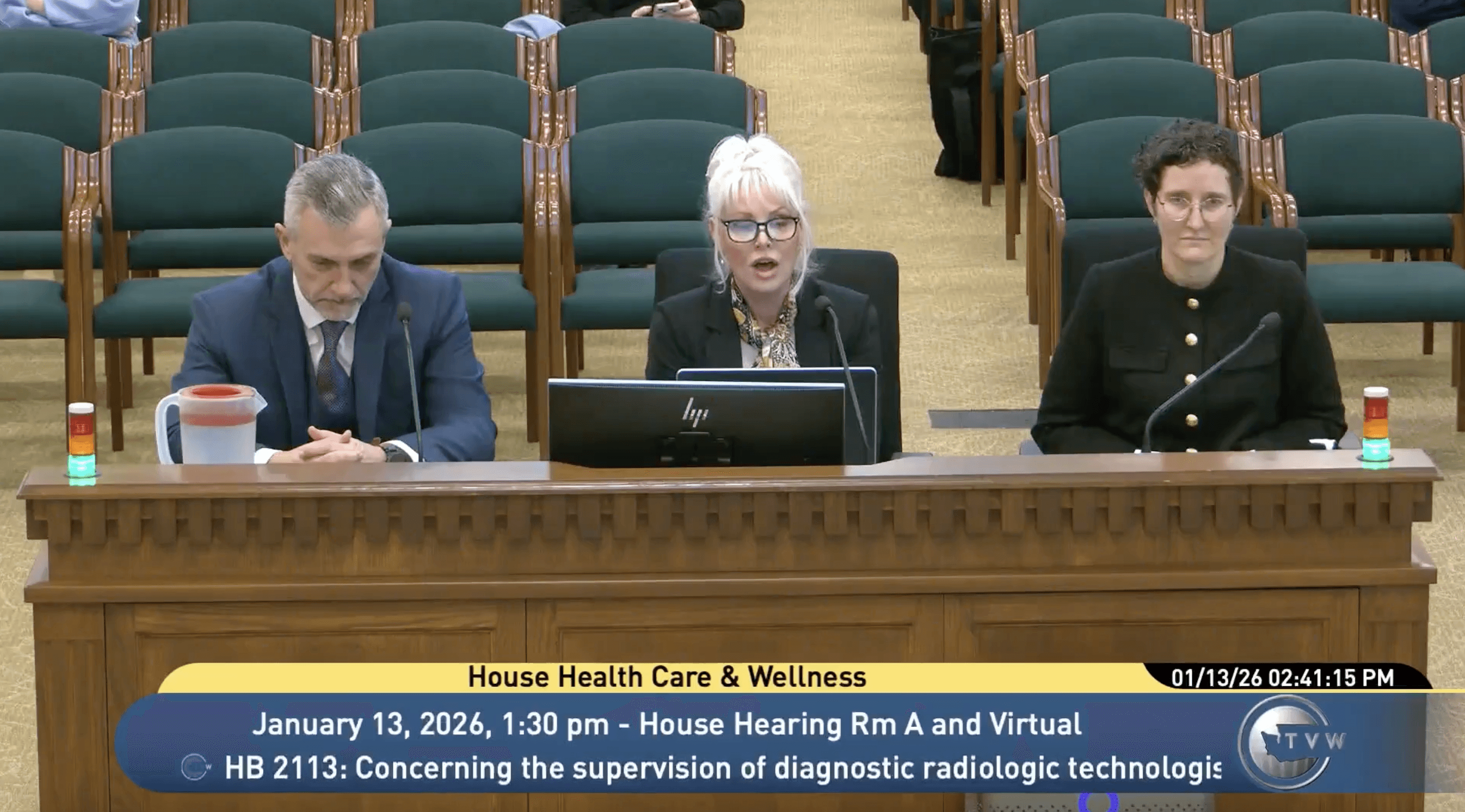
Similar bills include California's AB 460 and Washington's HB 1546 & SB 5299. States like Alabama and Tennessee have advanced waivers and amendments to X-ray rules to achieve similar modernization of definitions enabling virtual contrast supervision.
We Will Continue to Monitor Developments
Tether Supervision will track HB 479 through the committee process and provide timely updates as new hearings, amendments, or votes occur. For imaging centers and radiology groups evaluating operational planning for 2026, the bill’s progress is an important indicator of how Ohio intends to modernize contrast supervision in line with federal policy and contemporary clinical practice.
Questions about Virtual Contrast Supervision in Ohio
Is remote or virtual contrast supervision allowed in Ohio today under existing law?
Ohio law does not prohibit virtual supervision. Facilities that use real time physician availability combined with on site qualified personnel may structure operations in a way that remains consistent with current statute while awaiting legislative clarification through HB 479. Organizations should evaluate their policies with counsel to ensure alignment with state rules and CMS definitions. Tether offers both virtual and on-site contrast supervision in Ohio.
Does HB 479 change the training requirements for technologists who administer contrast?
No. The bill does not alter existing licensure or educational standards. It preserves institutional authority to set competency guidelines and requires that on site personnel meet those standards before participating in contrast administration.
Will imaging centers need to change their emergency protocols if HB 479 passes?
Most centers will not need to substantially revise emergency pathways. HB 479 requires use of treatment guidelines approved by institutional clinical leadership, which is already standard practice across accredited imaging environments. Centers may need to document qualifications for on site responders when general or remote supervision is used.


Tennessee Advances Amendment to X-Ray Rules to Modernize Contrast Supervision
On November 17, 2025, the Tennessee Board of Medical Examiners voted to approve a significant amendment to its X-ray supervision rules governing the use of contrast media. While the final regulatory text has not yet been published, the Board’s discussion and unanimous vote make the direction of the change clear.
The proposal first entered the Development Committee on September 19, 2025, where members began evaluating the need for a modernized supervision standard. Between September and November, the committee held discussions, gathered stakeholder input, reviewed training requirements, and ultimately advanced the amendment to the full Board for action. On November 17, 2025 the board unanimously passed that graduated Development Committee proposal.
A complete recording of the Board’s November 17 vote is available on the Tether Supervision YouTube channel here.
For imaging centers, radiology practices, and supervising physicians, this marks an important shift: Tennessee is preparing to modernize its supervision standards in a way that expands access, aligns with national policy, and maintains clinical safety.
What the Current Rule Says
Tenn. Comp. R. & Regs. 0880-05-.12:
(1) Before being authorized to perform any x-ray procedure or operate any x-ray equipment in a physician's office, the physician shall place a copy of the person's renewal certificate in the person's personnel file to prove the person being authorized has the appropriate certification required for either or both the procedure being performed and/or the equipment being used and that such certification is current.
(2) The employing physician(s), or a physician designated by the employing physician(s) as a substitute supervisor, shall exercise close supervision and assume full control and responsibility for the services provided by any person certified under this chapter of rules employed in the physician(s') practice. That supervision, control and responsibility, except when it involves contrast imaging or involves sedation, does not require the physical presence of the physician(s) at all times at the site where the services are being provided.
However, it does require that the physician(s) have his/her primary medical practice physically located within the boundaries of the state of Tennessee and that he/she be capable of being physically present at the site where the services are being provided within a reasonable time depending upon the type of x-ray being performed and the severity of the medical complications that may arise from that type of x-ray.
Under the current version of Tenn. Comp. R. & Regs. 0880-05-.12:
A physician does not need to be physically present to supervise most X-ray procedures.
But there are two exceptions:
Contrast administration, and
Sedation
These exceptions have historically required more restrictive, in-person supervision models.
What the Board Approved on November 17
Based on the transcript of the meeting, the Board approved an amendment that:
Updates the X-ray rules to address supervision for contrast administration.
The Board emphasized that the change is intended to increase access to care without compromising quality.
Allows contrast supervision to follow the same CMS supervision approach used for contrast X-ray procedures, rather than requiring physical presence.
Incorporates a training and competency framework, with explicit reference to ACLS and contrast-allergy-specific training requirements—an important safeguard the Board discussed in detail.
Applies not only to contrast supervision but also clarifies general supervision standards within this section of the rules.
Passed unanimously, with strong support from the Development Committee and no objections raised by the Board.
Once the final rule text is released, we will confirm the precise language. But the Board’s explanation makes the intent clear: Tennessee is embracing a modern, real-time model of supervision for contrast-enhanced imaging.
Why This Matters
1. Improved Access to Care
The Board underscored the need for greater flexibility, particularly for rural communities and high-volume centers that face staffing constraints. Updating the rule allows practices to staff more efficiently without sacrificing patient safety.
2. Alignment with Federal Policy
CMS has permanently authorized real-time audio-video technology to satisfy “direct supervision” requirements beginning January 1, 2026. Tennessee’s proposed amendment reflects this national shift.
3. Clearer Standards for Training and Safety
The Board highlighted the importance of formal training in managing contrast reactions and complications. This creates a consistent statewide expectation for technologists and supervising physicians.
4. A More Modern Framework for Imaging Centers
By moving away from rigid physical-presence requirements, Tennessee enables imaging centers to operate under a more efficient and predictable supervision model.
What Happens Next
The amendment now moves through Tennessee’s rulemaking process, including:
Finalization of the regulatory language
Filing with the Tennessee Secretary of State
Publication and effective date
As soon as the final text is published, we will provide a detailed analysis of:
Exact supervision requirements
Whether any location-based limitations remain
Technologist training expectations
Implementation timeline
Impact on hospital, outpatient, and mobile imaging providers
We Will Update This Article When the Final Rule Becomes Public
We will continue monitoring the Tennessee rulemaking process closely and will publish updates as more information becomes available. If you operate imaging centers in Tennessee or support supervision workflows, stay tuned—2026 may bring a more flexible, modern approach to contrast supervision statewide.