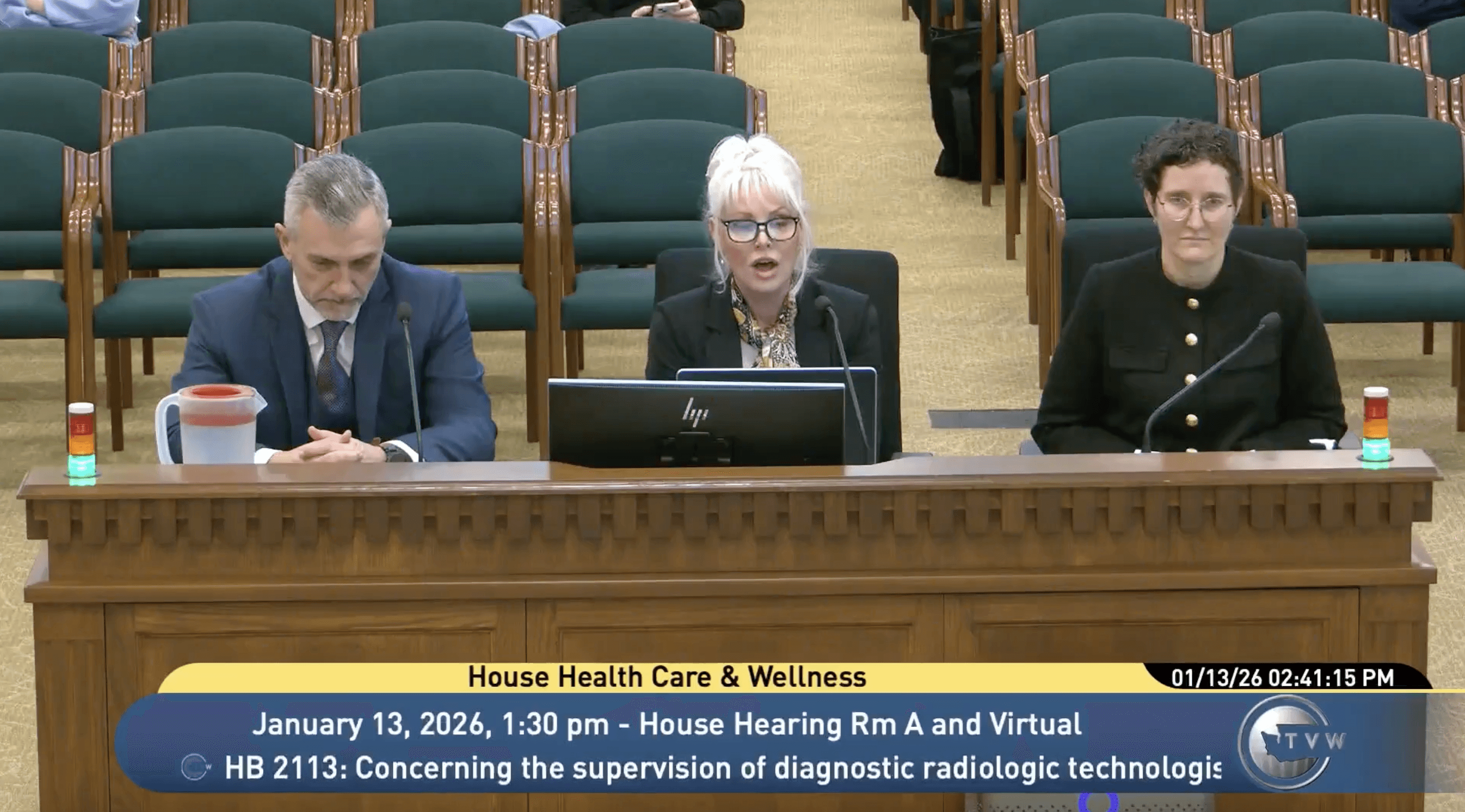
With two coordinated rules, the 2026 Medicare Physician Fee Schedule (PFS) Final Rule, issued October 31, 2025, and the 2026 Hospital Outpatient Prospective Payment System (OPPS) Final Rule, issued November 21, 2025, CMS has permanently authorized the use of real-time, two-way audio-video technology to meet “direct supervision” requirements for many diagnostic tests, including advanced imaging with contrast, across both office-based and hospital outpatient settings. These policies take effect January 1, 2026.
For imaging leaders, radiology groups, and hospital administrators, this is a structural change, one that reshapes how contrast-enhanced CT and MRI can be supervised, staffed, and scaled. For Tether Supervision, it further validates the model we were built for: safe, compliant virtual supervision paired with on-site support.
What CMS Means by Virtual Direct Supervision
Under both the PFS and OPPS rules, CMS maintains the classical definition of direct supervision: the supervising clinician must be immediately available to assist throughout the performance of the diagnostic test. What has changed is how that presence can be fulfilled. Beginning in 2026, immediate availability may be achieved via real-time, two-way, interactive audio and video. The connection must remain active and capable of supporting live intervention for the entire duration of the test. Audio-only communication does not satisfy the standard, and services associated with 010- and 090-day global surgical periods remain excluded due to safety and postoperative considerations.
This distinction is particularly relevant to advanced diagnostic imaging, where Level 2 tests such as CT with contrast and MRI with contrast have always required direct supervision. CMS’s updated rules mean that these contrast-enhanced studies can now be supervised virtually, provided the supervising radiologist or NPP maintains continuous, real-time audio-video availability and can interrupt other activities when needed.
The Role of State Law and Scope-of-Practice Requirements
Although the Medicare rules establish a federal baseline, CMS repeats in both the PFS and OPPS regulations that virtual direct supervision is permissible only where state law allows—or does not explicitly prohibit—remote supervision. Many states are modernizing radiologic technologist scope-of-practice statutes to align with contemporary imaging workflows, but others maintain legacy supervision frameworks or remain ambiguous regarding virtual supervision in contrast studies. Imaging centers, radiology groups, and health systems therefore must reconcile three layers of policy: CMS reimbursement rules, state practice acts and board guidance, and internal medical staff bylaws and privileging standards.
Because contrast administration often triggers specific state-level requirements around competency, escalation, and adverse reaction management, a careful review of state rules remains necessary even after CMS’s 2026 changes. A compliant virtual supervision program is one that satisfies Medicare’s technology requirements and state-based supervision constraints simultaneously.
Operational and Clinical Implications for Imaging Centers
For imaging leaders, these changes have immediate implications for staffing, coverage models, and workflow design. Virtual direct supervision allows a supervising radiologist to remain “immediately available” without being physically located in the imaging suite, enabling new models of multi-site coverage—particularly valuable in rural and underserved regions where securing on-site supervision has historically been challenging. Hospitals and health systems may now design hybrid models that combine qualified on-site technologists or nurses with a remotely available supervising physician, increasing the reliability of coverage while reducing staffing inefficiencies.
This shift places greater emphasis on training for on-site personnel, who must recognize and escalate adverse reactions, execute protocol adjustments under supervision, and operate within state scope-of-practice boundaries. It also requires imaging organizations to evaluate their technology infrastructure. Real-time audio-video capability must be HIPAA-compliant, stable, and documented. Audit trails—who supervised, when, and under which circumstances—become central to both compliance and risk management. Quality assurance programs will increasingly track response times, contrast reaction management, and adherence to virtual supervision protocols as part of continuous oversight.
Why This Matters for Contrast-Enhanced CT and MRI
Advanced imaging with contrast often represents the most operationally complex portion of outpatient radiology. These Level 2 diagnostic tests require oversight from a radiologist or qualified NPP who is immediately available to intervene should patient status change. By making virtual direct supervision permanent, CMS is aligning supervision standards with the realities of modern imaging: distributed networks, uneven geographic supply of radiologists, and rising demand for high-acuity diagnostic studies.
Virtual direct supervision offers imaging centers the ability to stabilize coverage, improve scheduling flexibility, reduce delays, and ensure that Medicare beneficiaries receive timely access to imaging—even when in-person supervision is not feasible. As a result, patients benefit from shorter wait times and more consistent quality of care across locations.
How Tether Supervision Supports Compliance and High Reliability
Tether Supervision was built for the workflows CMS has now formally recognized. Our platform—and the broader Tether model—supports real-time, HIPAA-compliant audio-video supervision that satisfies Medicare’s direct supervision requirements while integrating seamlessly with on-site technologists. We help clients align federal regulations with state laws, update internal supervision policies, and train teams to confidently operate under virtual supervision conditions. Because our model includes both virtual and on-site coverage when required, imaging centers can adapt to state variations and mixed-site footprints without the fragmentation seen in single-mode vendors.
Beyond compliance, Tether provides structured escalation pathways, incident reporting tools, and QA frameworks designed specifically for contrast-enhanced imaging. These systems allow organizations to demonstrate reliability and readiness—key considerations for hospital leadership, accreditation bodies, and regulatory reviewers.
Key Dates and What’s Next
The two foundational dates for imaging organizations planning 2026 operations are:
October 31, 2025 – CMS finalizes the PFS rule making virtual direct supervision permanent for Level 2 diagnostic tests in physician offices and IDTFs.
November 21, 2025 – CMS finalizes the OPPS rule extending the same virtual supervision standards to hospital outpatient departments, including off-campus provider-based departments.
January 1, 2026 – Both rules take effect, formally integrating virtual direct supervision into Medicare’s standard supervision framework.
Together, these changes mark a decisive shift toward modernized supervision in diagnostic imaging. For health systems preparing for 2026, the focus now turns to updating policies, aligning state law interpretations, credentialing supervising clinicians accordingly, configuring compliant A/V technology, and preparing on-site teams to operate confidently within virtual supervision workflows.
Tether Supervision will continue supporting organizations as they adopt these new standards, ensuring that patient safety, regulatory compliance, and operational efficiency remain at the forefront in this next era of contrast imaging supervision.